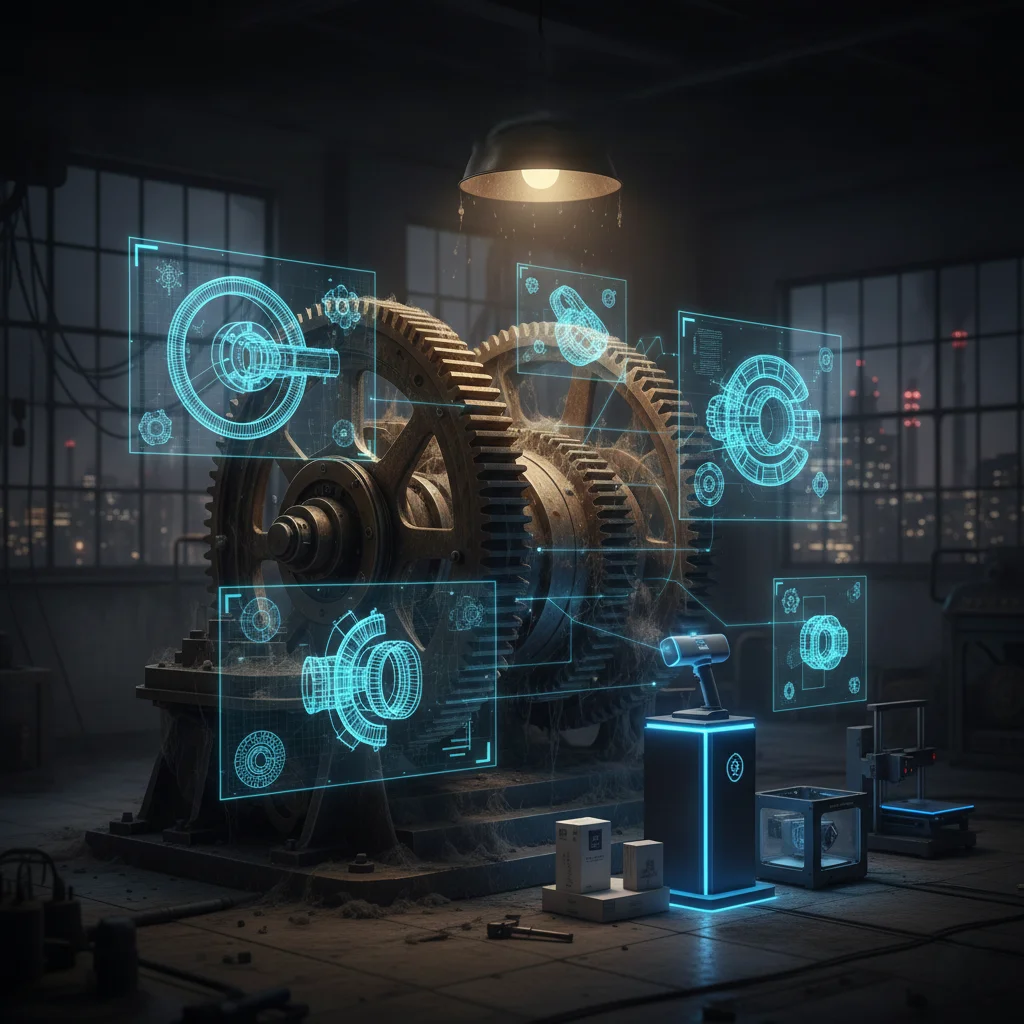
Executive Summary: Bridging the Generational Gap in Infrastructure
The global built environment is a tapestry woven from centuries of engineering prowess, yet this rich
history presents a formidable challenge: the pervasive issue of legacy machinery and infrastructure
nearing or exceeding its design life. From aging HVAC systems in historic structures to specialized
industrial components for which original schematics are long lost, the continued operation and
maintenance of these assets are critical to economic stability and cultural preservation. This
extensive analysis delves into the transformative power of reverse engineering (RE)
as a paramount methodology for revitalizing obsolete systems, ensuring operational continuity, and
significantly enhancing sustainability within the Architecture, Engineering, and Construction (AEC)
sector. RE is not merely about replication; it is a sophisticated process of deconstructing an
existing physical object to extract its design information, functional characteristics, and material
properties. For architects, structural engineers, and BIM managers, mastering RE techniques offers
an indispensable toolkit for structural assessment, part replacement, system upgrades, and seamless
integration into modern digital workflows, ultimately safeguarding invaluable assets against the
ravages of time and technological obsolescence. This article serves as an ultimate guide, exploring the technical trends, engineering methodologies, and profound sustainability implications of adopting reverse engineering as a cornerstone strategy for future-proofing our built heritage. For a broader service perspective, see an overview of reverse engineering services.
Industry Context: The Silent Crisis of Aging Assets
The industrial revolutions of the past two centuries left an indelible mark on our infrastructure,
birthing complex machinery and intricate structural systems. However, the rapid pace of
technological advancement and the often-ephemeral nature of documentation mean that a substantial
portion of these foundational assets now operate without adequate engineering records. This creates
a critical vulnerability for owners, operators, and the AEC professionals tasked with their
stewardship. Historically, the approach to failing or obsolete components was often outright
replacement, a costly and environmentally intensive endeavor. Today, with an ever-increasing
inventory of aging infrastructure – from municipal water treatment plants with custom-fabricated
pumps to historic building facades featuring unique ironwork – the imperative to find more
intelligent, resource-efficient solutions has never been greater. The current state is characterized
by dwindling availability of spare parts, loss of institutional knowledge regarding original design
intent, and the formidable challenge of integrating these physical relics into contemporary Building
Information Modeling (BIM) and digital twin ecosystems.
Key Technical Trends: The Digital Resurgence of the Physical
The modern era of reverse engineering is defined by an array of synergistic technologies that empower
precise digital capture and intelligent reconstruction. These advancements are rapidly transforming
how architects, structural engineers, and BIM managers interact with legacy assets.
- 3D Laser Scanning & Photogrammetry: These non-contact methods are foundational
for rapidly acquiring geometric data from physical objects. 3D laser scanners
capture millions of precise coordinate points (a "point cloud") with sub-millimeter accuracy,
ideal for complex geometries. Photogrammetry uses overlapping photographs to
create 3D models, offering a cost-effective alternative for certain applications, particularly
large structures or inaccessible areas.
- CAD/CAM Integration: Transforming raw point cloud data into actionable
parametric CAD models (e.g., SolidWorks, Revit, Inventor) is crucial. This
allows for not just replication, but also modification, optimization, and the generation of
manufacturing data (CAM) for producing replacement parts.
- Finite Element Analysis (FEA) & Computational Fluid Dynamics (CFD): Once a
digital model is reconstructed, advanced simulation tools become invaluable.
FEA can analyze structural integrity, stress distribution, and predict failure
modes of re-engineered components, while CFD can model fluid flow for
components like pumps or ventilation systems, ensuring performance matches or exceeds original
specifications.
- Additive Manufacturing (3D Printing): The ability to produce complex, bespoke
replacement parts on demand, often from specialized alloys or polymers, is a game-changer.
3D printing reduces lead times, eliminates the need for expensive tooling, and
enables the fabrication of geometries impossible via traditional methods.
- Digital Twin & BIM Integration: Reverse-engineered models are vital inputs for
creating or updating digital twins and enriching BIM models.
This integrates physical assets into a comprehensive digital framework, enabling lifecycle
management, predictive maintenance, and operational analytics.
- AI/ML for Data Interpretation: Artificial Intelligence and Machine Learning
algorithms are increasingly used to automate the processing of dense point clouds, identify
features, detect anomalies, and even suggest optimal reconstruction parameters, significantly
accelerating the RE workflow and improving accuracy.
Engineering Deep Dive: The Art and Science of Reconstruction
The "how" of reverse engineering legacy machinery is a multi-stage process demanding a blend of
advanced technology, engineering expertise, and meticulous attention to detail. It is a journey from
the physical to the digital, and back again, with rigorous validation at each step.
Methodology of Reverse Engineering
- Data Acquisition: This initial phase involves selecting the most appropriate
scanning technology. For intricate mechanical components requiring high precision,
structured light scanning or industrial computed tomography (CT)
scanning might be employed for internal geometries. For larger structural elements
or exterior surfaces, terrestrial laser scanning offers speed and range. The principle involves
projecting light patterns or laser beams and measuring their deformation or time-of-flight to
derive 3D coordinates.
- Data Processing: Raw point clouds are inherently noisy and fragmented. Software
tools perform registration (aligning multiple scans), noise
reduction (filtering spurious points), and meshing (connecting
points to form a polygonal surface, e.g., using algorithms like Marching Cubes). This creates a
tessellated model, a digital representation of the object's surface.
- Model Reconstruction: The most intellectually demanding phase. Engineers
interpret the meshed data to extract geometric primitives (planes, cylinders, spheres) and
construct a feature-based, parametric solid model in CAD software. This often
involves inferring design intent – understanding radii of fillets, dimensions of bores, and
relationships between features – rather than simply tracing surfaces. For highly organic or
artistic shapes, NURBS (Non-Uniform Rational B-Splines) surfaces are employed for smooth,
precise representation.
- Validation & Verification: Critical for ensuring the accuracy and usability of
the re-engineered model. This involves comparing the CAD model back to the original point cloud
data (often using color deviation maps), performing dimensional checks against physical
measurements, and sometimes destructive or non-destructive material testing to ascertain
metallurgical properties, hardness, and internal structure. For example, in replicating a
complex turbine blade, deviations must be within micron-level tolerances, requiring statistical
analysis of measurement uncertainties.
Theoretical Case Study: Restoring a Historic Bridge Bearing
Consider a cast-iron roller bearing from a late 19th-century railway bridge, exhibiting severe wear
and no existing documentation. Reverse engineering would involve: 1) High-resolution laser scanning
of the bearing and its housing. 2) Point cloud processing to generate a precise mesh. 3)
Reconstruction of the bearing's complex geometry into a parametric CAD model, inferring original
dimensions from worn surfaces using best-fit algorithms. 4) Material analysis (e.g., XRF for
elemental composition, hardness testing) to match or improve upon the original cast iron. 5) FEA to
simulate load distribution and ensure the replicated part meets current structural codes and
projected lifespan, potentially recommending minor design improvements for enhanced durability. This
process could save millions compared to full bridge replacement and preserve the historical
integrity of the structure.
Sustainability Analysis: The Greener Side of Legacy Revival
Reverse engineering offers profound environmental and economic advantages, aligning directly with
principles of the circular economy and contributing significantly to sustainable development goals
within the AEC industry.
- Circular Economy Principles: By extending the operational life of existing
machinery and infrastructure, RE directly supports the "maintain, repair, reuse" hierarchy. It
dramatically reduces waste generation from disposal of obsolete assets and minimizes the demand
for new raw material extraction and processing. This shifts the paradigm from a linear
"take-make-dispose" model to a regenerative one.
- Reduced Carbon Footprint: Manufacturing new, complex machinery from virgin
materials is highly energy-intensive, involving mining, smelting, fabrication, and extensive
transportation. By reverse engineering and selectively replacing worn components, the embedded
carbon footprint associated with the original asset is retained and maximized. For instance,
refurbishing a critical industrial pump through RE can save an estimated 70-90% of the energy
and emissions compared to manufacturing a new unit.
- LEED & Green Building Impact: Projects utilizing reverse engineering can
contribute positively to various LEED (Leadership in Energy and Environmental Design)
categories. Specifically, it aligns with credits for Materials and Resources
(MR), by promoting reuse of existing building stock and components, and potentially
for Innovation (IN) through novel applications of technology for
sustainability. Furthermore, by improving operational efficiency of legacy systems (e.g.,
through optimized replacement parts), it can indirectly support Energy and Atmosphere
(EA) credits.
- Resource Efficiency: Beyond carbon, RE conserves other valuable resources such
as water, land (for landfills), and minimizes pollution associated with industrial
manufacturing. It promotes localized manufacturing of parts through 3D printing, reducing
transportation impacts.
Future Roadmap (2030+): AI, Automation, and Hyper-Connected Assets
The trajectory of reverse engineering in the AEC sector is poised for dramatic acceleration, driven
by AI, advanced robotics, and pervasive digital integration.
- Hyper-Realistic Digital Twins: By 2030, reverse-engineered models will not just
be static CAD files but dynamically updated components of highly intelligent digital
twins. These twins will incorporate real-time sensor data, AI-driven performance
analytics, and predictive maintenance schedules, creating a living, breathing digital replica of
physical assets.
- AI-driven Design Automation: The laborious process of converting point clouds
to parametric CAD models will be largely automated. Advanced AI algorithms, trained on vast
datasets of engineering components, will be capable of autonomously identifying features,
inferring design intent, and generating editable CAD geometry with minimal human intervention.
This will drastically reduce turnaround times and costs.
- Robotics in Data Capture: Autonomous drones equipped with multi-spectral
sensors and laser scanners will become standard for inspecting and capturing data from
large-scale infrastructure (bridges, complex facades, industrial plants). Robotic arms and
mobile platforms will handle intricate internal component scanning in hazardous or confined
spaces, enhancing safety and data quality.
- Advanced Materials & Hybrid Manufacturing: The integration of reverse
engineering with cutting-edge materials science will enable the creation of
"better-than-original" replacement parts. Hybrid manufacturing techniques, combining additive
and subtractive processes, will allow for bespoke components with optimized material properties
(e.g., gradient materials, internal lattices for lightweighting) tailored precisely to specific
stress conditions.
- Standardization of RE Workflows: Industry bodies will establish comprehensive
standards for data acquisition protocols, point cloud processing, model fidelity, and data
exchange formats, fostering greater interoperability and ensuring quality assurance across
reverse engineering projects globally.
Conclusion: A Pillar of Resilient and Sustainable Engineering
Reverse engineering, once a niche practice, has evolved into a cornerstone methodology for ensuring
the resilience, sustainability, and operational longevity of our global infrastructure. For
architects, structural engineers, and BIM managers, proficiency in these techniques is no longer
optional but essential. By leveraging advanced digital capture, sophisticated modeling, and rigorous
analysis, RE empowers professionals to intelligently assess, repair, and upgrade assets that would
otherwise be deemed unsalvageable. It epitomizes the principles of the circular economy, drastically
reducing environmental impact while simultaneously delivering significant economic value. As we
navigate an era of unprecedented technological change and increasing resource scarcity, reverse
engineering stands as a testament to human ingenuity – an elegant solution that bridges the past
with the future, transforming obsolescence into opportunity and ensuring that our built heritage
continues to serve generations to come.